

Written by
Camelia
28 October, 2025
Symbolic experience is central to transpersonal processes. When consciousness expands beyond ordinary perception, the psyche often expresses itself not through logical thought, but through images, colors, archetypal forms, and symbolic narratives.
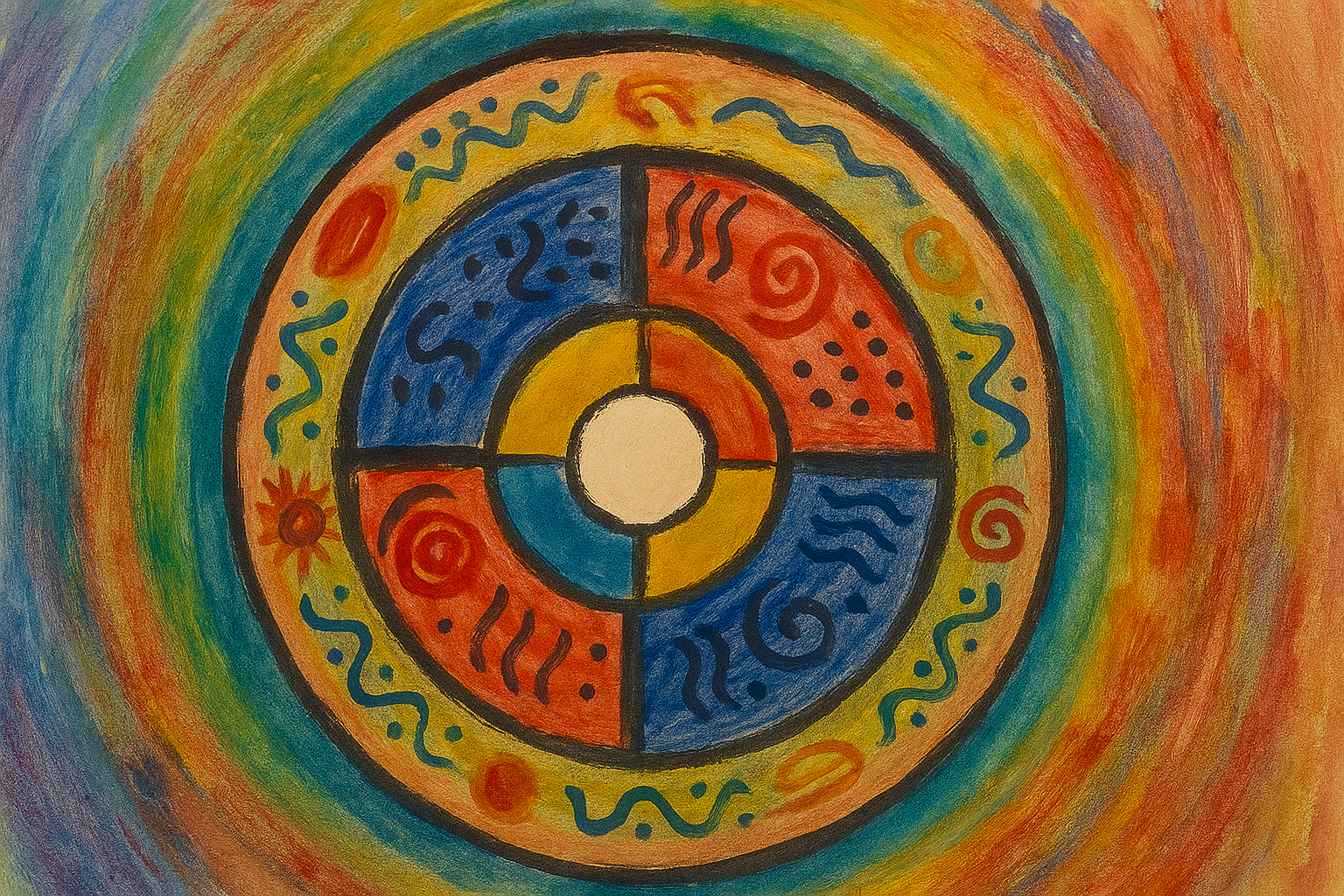
In Pneuma Breathwork, one of the most powerful tools for integrating these experiences is mandala drawing — a universal method of translating inner material into a coherent visual representation.
Symbol as the Language of the Deep Psyche
Carl Jung viewed symbols as bridges between the unconscious and consciousness.
Grof observed that during breathwork, people often encounter:
- archetypes
- mythological motifs
- geometric patterns
- perinatal symbolism
- ancestral images
- mythic landscapes
These are not random hallucinations. They are structured messages from the psyche, revealing emotional truth, unresolved material, or stages of psychological evolution.
Why Mandalas Are Used After Breathwork
Drawing a mandala after breathwork allows participants to:
- stabilize the nervous system
- externalize and organize the inner journey
- honor emotional or spiritual insights
- integrate symbolic content visually
- reestablish coherence after intense experiences
Mandalas reveal themes from:
- the personal unconscious
- perinatal sequences
- transpersonal dimensions
- inner archetypes
- spiritual states
- mythic or ancestral memory
The act of drawing itself becomes a meditative extension of the breathwork.
Symbolic Patterns Common in Mandala Work
Participants may intuitively draw:
- spirals (growth, evolution, emergence)
- circles (wholeness, unity, Self)
- fire or waves (BPM III energy)
- tunnels or gateways (initiation, transition)
- animals or mythic beings (archetypal guidance)
- womb-like shapes (BPM I or perinatal themes)
- geometric grids (order emerging from chaos)
Facilitators do not interpret mandalas for clients; rather, they support self-reflection, allowing the individual to discover the meaning organically.
Mandalas as Transpersonal Integration
Mandalas transform ephemeral inner experiences into stable, tangible forms.
They act as:
- mirrors of the psyche
- anchors for memory
- symbolic containers
- maps of the inner world
In Pneuma Breathwork, mandala work is not art therapy — it is a spiritual cartography, an expression of the soul’s movement toward unity and expanded awareness.